21–40 of 1161 results
Ceramic tiles have covered the walls of Ottoman palaces, Portuguese railway stations, Moroccan riads, and California Craftsman bungalows. Each tradition is distinct, each rooted in the same elemental sequence of clay, fire, and glaze. At Country Floors, ceramic tiles span two distinct production worlds: artisan tile collections that carry the imperfections and character of their makers, and high fired architectural ceramics, to provide you with the same perfection in your residential or commercial tile projects. To choose the best option for your vision and space, you need to understand the difference between these two. Having studied heritage patterns for decades, we can inform you about what's best.
Ceramic is not a single material. It is a process: clay shaped into form, dried, fired at high temperature, and sealed with a glaze that becomes glass hard in the kiln. What changes between a handcrafted Portuguese azulejo and a precision fired ceramic field tile is not the fundamental chemistry; it is the intent, the hand, and the tolerance. During on-site consultations, we often advise our clients that they should decide what they need exactly and order a sample to test the circumstances.
In hand pressed production, wet clay is shaped using original handmade molds, trimmed by hand, and dried before its first firing. Glazes are mixed to proprietary formulas, some unchanged for generations, and applied by hand or hand spray before a second firing. Because wet clay shrinks unevenly as it dries, no two tiles emerge from this process at exactly the same dimensions. A variation of approximately 1/16" between tiles in the same shipment is not a manufacturing error. It is the physical record of a human process. And that's what makes a ceramic tile authentic, the imperfection and the human fingerprint in the process.
Having worked with these materials across high end residential and commercial tile installations, we've noticed that the clients most satisfied with handmade ceramic are those who understand this tolerance before the first tile is set, not after. The variation is not something to minimize and ignore. It is something to design with.
This also means that crazing, the network of hairline cracks that can appear in a glaze after firing, is an inherent characteristic of hand pressed ceramic tiles, not a defect. On a sealed wall surface, crazing does not affect cleanability or structural performance. The most frequent feedback we hear from clients after experiencing these tiles is that crazing becomes invisible in daily life and meaningful in close inspection. Choosing artisan ceramics means that you should embrace the imperfections and make them live on your walls with the authentic aesthetic of each tile.
At the other end of the Country Floors ceramic range are high fired architectural ceramics developed in partnership with our precious interior designs, such as Sister Parish Design. These tiles are shaped with precision tooling, fired at higher temperatures for lower porosity, and finished to tight dimensional tolerances. Shade variation is controlled, edges are clean, and sizing is consistent.
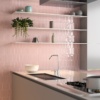
Professionals typically specify these when the brief calls for a surface that recedes rather than asserts, where the architecture leads, and the tile supports. In an average home, just like we all have, we see this range performing best as kitchen tiles, bathrooms, and commercial interiors, where restraint is the design language, and longevity is the priority. Don't think that they're less because they're manufactured. They still carry the high end aesthetic approach of Country Floors designs.
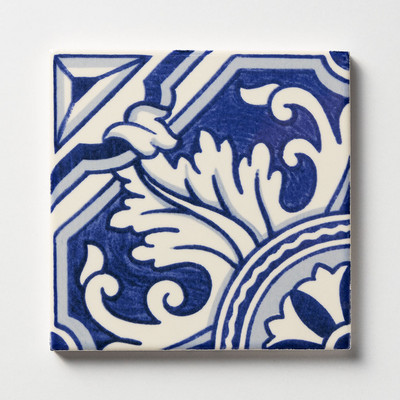
The word azulejo does not mean blue tile. It derives from the Arabic az-zulayj: small polished stone, and the tradition it names encompasses far more than the blue and white patterns that became dominant through 17th-century Dutch influence, with the Delft Tile collections.
The original azulejo tradition arrived in Portugal with Moorish traders in the 13th century, carrying geometric and calligraphic motifs from across the Islamic world. Over the following centuries, Portuguese artisans absorbed Spanish, Flemish, and Chinese influences, producing a ceramic language so embedded in national identity that azulejos cover the facades of churches, railway stations, palaces, and ordinary houses across the country today.
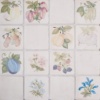
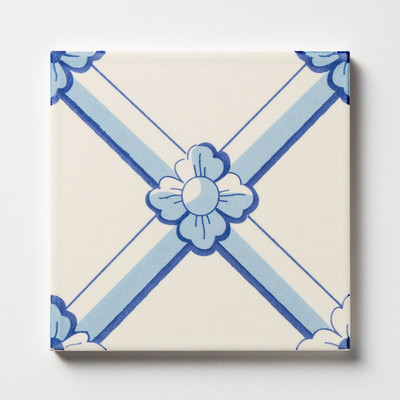
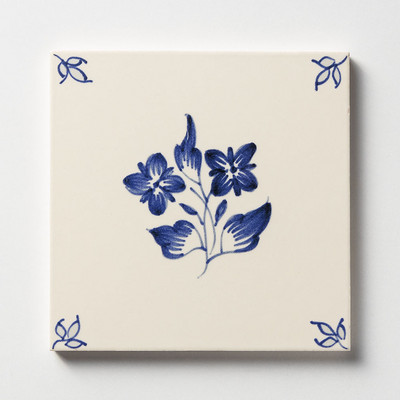
Country Floors' Miradouro Ceramic Tile collection is produced by artisans in Portugal working from original designs. Each tile is hand painted and carries the soul of Portugal into your new cottagecore inspired kitchen and more. The white ground is not pure white; it carries the warmth of the clay beneath and the slight unevenness of a brush held by a person, not a machine. A recurring question we get during consultations is whether this variation can be controlled or minimized at installation. It cannot, and we would not recommend trying. The variation is the collection, that what makes Azulejos a part of the tradition.
In 10th-century Andalusia, ceramic makers developed a solution to a specific problem: when two differently colored glazes are applied to the same tile surface and fired together, they bleed into each other at the boundary. The solution was cuerda seca, dry cord, a line of wax or manganese based resist drawn between glaze areas before firing. The resist burns away in the kiln, leaving a fine, unglazed line that holds the colors apart and creates the precise, breathtaking color separation characteristic of Moorish and Spanish tiles.
A common trade secret for achieving the full visual impact of cuerda seca ceramic is the lighting angle. The unglazed resist line creates a subtle shadow at oblique light that makes the color fields appear almost lacquered. We recommend reviewing samples in the actual installation lighting before finalizing a colorway selection. In our La Brea and Catalina Ceramic Tile Collections, we're proud to bring you the stories of the Mediterranean with the special technique of the craftsman. Both are made to order and available in custom colorways.
What we look for when sourcing ceramics from this region is consistency of glaze depth across a full production run, not just surface color, but the way light moves through the glaze at different angles.
Country Floors' ceramics are available in 2×4, 2×8, and 4×4 tile formats and more. And if you're not sure about the surface you'd like to have, we provide ceramic wall tiles in matte, glazed, and glossy finishes, rated for interior use.
| Feature | Artisan Ceramic Tiles | Architectural Ceramic | Porcelain Tiles |
|---|---|---|---|
| Water Absorption Rate | 3–7% | 1–3% | <0.5% |
| Dimensional Tolerance | ±1/16" | ±1/32" | ±1/32" |
| Shade Variation | Medium–High | Low–Medium | Low |
| Typical application | Walls, Backsplash | Walls, Light-traffic Floors | Floors, Wet Areas, High-Traffic |
| Surface character | Each Tile Unique | Controlled, Consistent | Uniform |
| Crazing | Expected in hand pressed | Rare | Not present |
Let's leave a note here: Country Floors ceramic tiles, both artisan and architectural, are the correct specification for walls, backsplashes, shower wall tiles, ceramic tiles for bathroom and kitchen applications, and any surface where the tile is doing visual work. For primary floor installations in high traffic or continuously wet environments, we mostly recommend our natural stone, terracotta, or porcelain tile floor options.
We've observed that over long term use, glazed ceramic wall tiles in kitchen and bathroom environments maintain their surface quality with minimal intervention; a pH neutral soap and warm water is the complete maintenance requirement. Contractors frequently specify these over stone alternatives for clients who want the visual richness of an artisan tile without the sealing schedule that natural stone demands.
Ordering a sample of Country Floors ceramic tile is not a formality. It is a specification step for your special project, because every project and space needs its own perfect material options.
For hand painted tile collections, the sample communicates glaze depth, color temperature, and surface texture in a way that photography cannot. The warmth of a Miradouro white ground, the exact line weight of a cuerda seca border, the degree of crazing in a crackle glaze. These are decisions made in person, in your lighting, against your furniture, and overall interior design harmony. During several recent installations, we found that clients who had reviewed samples in situ made significantly fewer change requests mid project than those who specified from photography alone.
For the architectural field of ceramics, the sample confirms shade and finish in the context of your project. Even controlled production carries variation between lots. Always confirm lot numbers before finalizing quantities, and order 15% overage from the same lot to cover cuts and future repairs.
One installation note that applies to all hand painted ceramics: always blend tiles from multiple cartons before setting. Individual cartons may concentrate tiles from one area of a kiln run. Blending produces a natural, even distribution of the variation that is inherent to the material and prevents visible banding across a completed wall. Industry standards suggest that for the best results, this blending step happens on the floor before a single tile is adhered, not as an afterthought once installation has begun.
Country Floors ceramic tiles are available through our ceramic tile showrooms and trade program, with lots of benefits. For the tile collections that are made to order, contact our team to discuss lead times and project scope before finalizing quantities.